Mastering AI Writing: Let AI Post, Easily Win Traffic
In the digital age, content is king, yet consistently producing high-quality, engaging content is a major challenge for many. Fortunately, with the rapid development of Artificial Intelligence (AI) technology, especially generative AI, we've entered a new era of content creation where AI writing and posting are rapidly becoming widespread trends.

In the digital age, content is king. However, continuously producing high-quality, engaging content has become a significant challenge for many personal brands, businesses, and marketers. Fortunately, with the rapid development of Artificial Intelligence (AI) technology, especially the rise of generative AI, we are entering a new era of content creation. AI writing and AI posting are no longer distant future concepts but an established and rapidly popular trend that is profoundly changing content creation and marketing models.
These powerful AI tools can help us produce content at unprecedented speed and efficiency. This not only significantly boosts productivity but also helps us stand out in a competitive market. However, to truly harness this AI wave and gain more traffic and attention, we must deeply understand AI's potential, master key usage techniques, and view AI as a powerful assistant in our content creation journey, rather than merely a content generation machine.
This article will guide you through the core concepts of generative AI, explore AI writing applications in various scenarios, analyze its advantages and challenges, and provide practical AI tool choices and content optimization strategies. By mastering these key knowledge and skills, you will be able to use AI more effectively, make content creation effortless, and gain more attention in the digital world.
What is Generative AI?
Before we delve into how to use AI for writing, it's essential to have a clear understanding of "Generative AI." This technology is the core driving force in the current AI content creation landscape.
Basic Definition of Generative AI
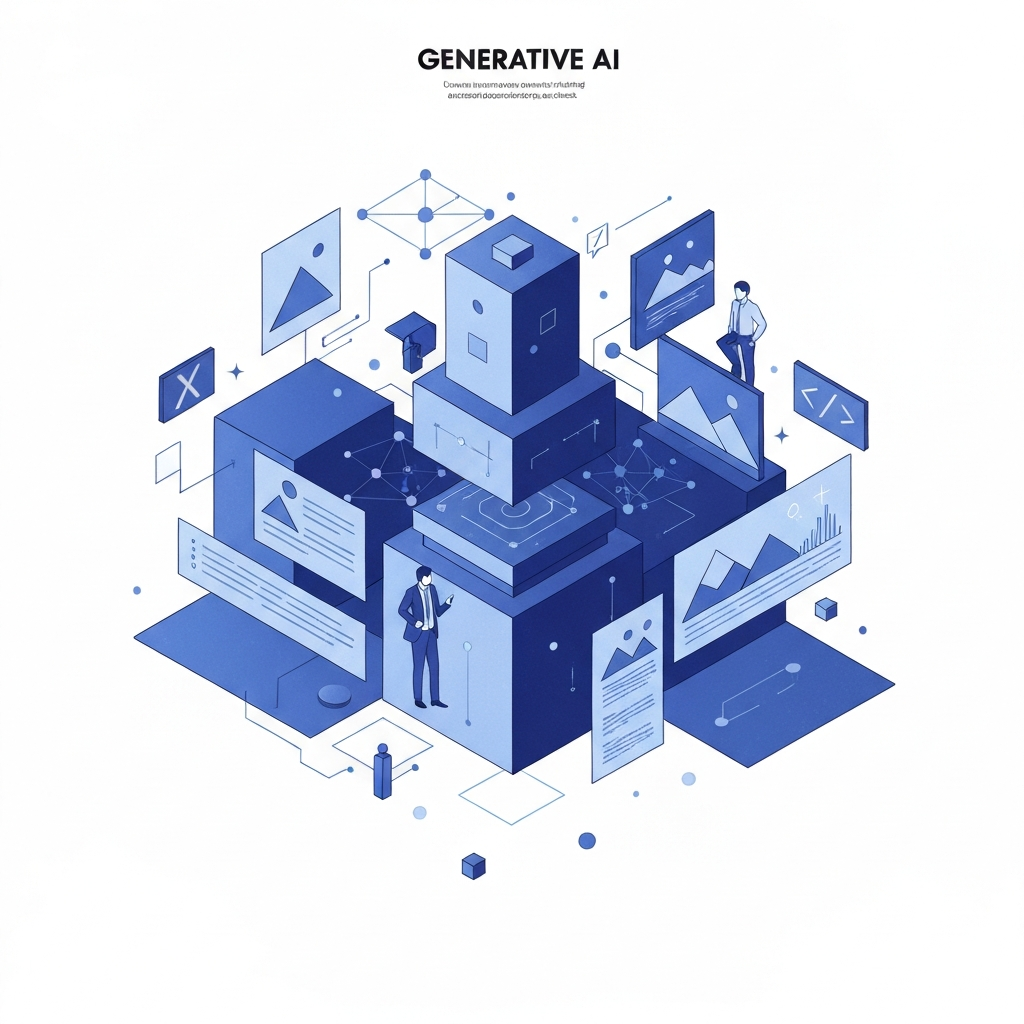
Generative AI refers to a class of AI models capable of creating new, original content. Unlike traditional AI, which is primarily used for analysis, classification, or prediction, the key to generative AI lies in its "creation" ability. It not only understands existing data but can also generate new text, images, audio, video, and even code based on that data.
Imagine giving AI a topic, a piece of text, or an image, and it can "create" a related article, a brand new painting, or a soundtrack. This ability to generate from scratch (or from parts to a whole) is the most astonishing feature of generative AI.
Exploring its Core Principle: Large Language Models (LLM)
Generative AI primarily relies on "Large Language Models" (LLMs) for text content generation. These models are trained on vast amounts of text data, learning the structure, semantics, contextual relationships, and correlations between different words in language.
The core principle of LLMs can be simplified as:
- Predicting the next word: During training, LLMs learn to predict the most likely next word in a sentence. Through this probabilistic prediction, they can string together coherent and meaningful sentences and paragraphs.
- Understanding context: With advanced "Attention Mechanisms," LLMs can consider information from both preceding and subsequent text when generating content, thus producing more logical and coherent content.
- Learning patterns and knowledge: Through training on massive datasets, LLMs not only learn linguistic rules but also indirectly acquire a vast amount of world knowledge, reasoning abilities, and writing styles.
Therefore, when we ask questions or give commands to LLM-based tools like ChatGPT, it is actually using its extensive knowledge base and language model to predict and generate answers or texts that best meet our needs.

Rapid Development and Potential of Generative AI
The development of generative AI was not instantaneous but evolved over many years. From early image generation models to today's LLMs capable of writing complex articles and programming, the pace of progress has been remarkable.
- Early stages: In the past, AI's capabilities in content generation were relatively limited, often producing content that felt stiff, unnatural, or lacked creativity.
- Recent breakthroughs: The advent of the Transformer architecture and leaps in computing power made it possible to train larger, more accurate language models, giving rise to a series of groundbreaking LLMs like GPT-3 and GPT-4.
- Wide applications: Today, generative AI applications have permeated various industries. In content creation, it can automatically write news, generate ad copy, and create poetry; in programming, it can automatically generate code; in artistic creation, it can generate unique images and music.
The potential of generative AI far exceeds our current imagination. It can not only increase productivity but also inspire new creativity and change how we learn, work, and interact. For content creators, understanding and leveraging generative AI will be key to mastering future competitiveness.
Application Scenarios for AI Writing
Generative AI demonstrates great flexibility in text content creation and can be applied to a variety of different scenarios, greatly expanding our content output capabilities.
Blog Post Generation
This is one of the most common and popular applications of AI writing. AI can:
- Quickly generate drafts: By entering a topic or a few keywords, AI can generate a complete, initial article draft in a short time, saving creators a lot of time.
- Expand content: When creators hit a roadblock or need to elaborate on a point, they can ask AI to expand on existing content, providing more angles and details.
- Rewrite and refine: AI can also help rewrite existing articles to better match a specific tone, style, or optimize for different audiences.

Product Description Writing
In the e-commerce sector, precise and attractive product descriptions are key to boosting sales. AI can:
- Customize for different platforms: Generate corresponding product descriptions based on the word limits, formatting requirements, and style preferences of different e-commerce platforms (e.g., Amazon, Shopify, own website).
- Highlight product selling points: AI can analyze product features and, based on market demand, write copy that highlights the product's unique selling points (USPs).
- Multi-language generation: Quickly generate product descriptions in multiple languages, helping brands expand into international markets.
Social Media Content Creation
The rapid iteration of social media requires continuous content updates. AI plays an important role here:
- Generate posts: Quickly generate post content suitable for platforms like Facebook, Instagram, and Twitter based on products, events, or topics.
- Design eye-catching headlines: Write headlines that attract user clicks and engagement.
- Recommend Hashtags: Suggest relevant and popular hashtags based on post content to increase post visibility.
- Respond to interactions: Generate polite and informative replies to common user questions or comments.
Email Marketing and Ad Copy
Improving the appeal of marketing content is key to increasing conversion rates. AI can help:
- Design compelling subject lines: Write email subject lines that boost open rates.
- Write persuasive body copy: Generate email body content that guides users to take action (e.g., purchase, register) based on marketing goals.
- Generate diverse ad copy: Create different versions of ad headlines and body content for platforms like Google Ads, and Facebook Ads for A/B testing.
- Customize marketing messages: Generate more personalized marketing messages based on user interests and behavior.
The table below shows the main applications of AI in different content creation scenarios:
| Application Scenario | Main Functions | Example Content Output |
|---|---|---|
| Blog Post Generation | Generate drafts, expand content, rewrite/refine | Blog posts, guides, reviews, news reports |
| Product Description Writing | Highlight selling points, customize platforms, multi-language generation | E-commerce product descriptions, catalog text, product comparison tables |
| Social Media Content Creation | Generate posts, headlines, hashtags, replies | Facebook posts, Instagram captions, Twitter snippets, LinkedIn updates |
| Email Marketing & Ad Copy | Design subject lines, write body, generate ad copy, customize messages | Marketing emails, promotional messages, ad headlines, Call to Action button text |
Advantages and Challenges of AI Posting
Applying AI to content creation undoubtedly brings immense opportunities for creators, but it also comes with some undeniable challenges.
Enhanced Efficiency and Productivity
This is the most significant advantage of AI writing.
- Reduced content production cycle: AI can generate thousands of words of content in minutes, far exceeding human writing speed.
- Increased publishing frequency: With AI assistance, content teams can significantly increase content output frequency, maintaining website or community activity.
- Liberated human resources: Delegating repetitive, time-consuming writing tasks to AI allows human creators to focus on more strategic, creative, and deep-thinking work, such as content planning, strategy formulation, in-depth interviews, and final editing and refinement.
Content Quality and Originality
While AI can quickly generate text, content quality and originality are crucial considerations.
- Quality standards: AI-generated content, especially when not finely tuned with precise instructions (Prompt Engineering), may appear generic, lack depth, or contain factual errors.
- Originality issues: AI learns from existing data, and sometimes may generate text highly similar to existing content, raising plagiarism concerns. Although AI-generated text is technically "new," the source of its "creativity" and its "uniqueness" need careful evaluation.
- Style and emotion: AI finds it difficult to fully mimic subtle human emotional expression, unique personal style, or deep personal insights.
Potential Ethical and Legal Issues
The widespread application of AI content also brings new ethical and legal issues.
- Copyright ownership: The copyright ownership of AI-generated content is a complex issue, and there is currently no unified legal conclusion. Does it belong to the AI developer? The user? Or the public domain?
- Information accuracy: AI may "confidently spout nonsense," generating information that seems plausible but is actually incorrect. This is particularly dangerous in specialized fields like medicine and finance.
- Bias and discrimination: AI training data may contain societal biases, leading AI-generated content to also carry discriminatory or unfair viewpoints.
- Transparency: In some cases, users may need to know if content is AI-generated to judge its credibility.
SEO Considerations
AI content's impact on Search Engine Optimization (SEO) is a double-edged sword.
- Positive impact:
- Keyword optimization: AI can quickly generate content containing target keywords based on keyword research results.
- Content expansion: AI can help fill long-tail keyword content, increasing website search coverage.
- Structured data: AI can assist in generating structured content, such as lists and tables, improving user experience.
- Negative impacts and challenges:
- Content quality: If AI-generated content is low quality, highly repetitive, and fails to meet user needs, it will be penalized by search engines.
- Insufficient originality: Search engines tend to reward original, in-depth content that provides unique value. Content heavily reliant on AI and not manually optimized may struggle to rank well.
- Over-optimization: AI may inadvertently generate content that overstuffs keywords, which is detrimental to SEO.

For AI content to succeed in SEO, the key is to use AI as an aid, combining human editing, creativity, and an understanding of SEO principles to produce content that truly provides value to users.
How to Effectively Use AI Tools for Content Creation
Mastering the use of AI tools and combining them with human intelligence is key to unleashing AI's full potential.
Choosing the Right AI Tools
There are numerous AI writing tools on the market, each with its own features. Choosing the right tool for your needs is crucial. Here are some mainstream AI writing tools:
- ChatGPT (OpenAI):
- Features: Powerful, conversational interface, capable of handling a wide range of tasks from writing and coding to information retrieval.
- Suitable for: Almost all text creation scenarios, especially ideal for users needing creative brainstorming, text generation, and conversational interaction.
- Jasper:
- Features: Designed specifically for marketing and content creation, offers numerous templates (e.g., blog posts, ad copy, social media posts), focuses on producing high-quality business content.
- Suitable for: Digital marketers, content creators, businesses.
- Copy.ai:
- Features: User-friendly interface, offers multi-language support, excels at generating short marketing copy such as product descriptions, ad slogans, and social media posts.
- Suitable for: E-commerce sellers, social media managers, small businesses.
- Writesonic:
- Features: Integrates various AI writing functions, including blog posts, ads, product descriptions, and emphasizes SEO optimization.
- Suitable for: Content creators and marketers who need an all-in-one solution.
- Rytr:

When choosing a tool, consider the following factors:
- Feature requirements: What type of content do you primarily need AI to help with?
- User interface: Is the tool easy to learn and use?
- Price budget: Different plans such as free versions, subscriptions, or pay-as-you-go.
- Output quality: The fluidity, relevance, and originality of the generated content.
- Integration: Can it integrate with your existing workflows or platforms?
Combining Human Creativity with AI Assistance
AI is a powerful tool, but it cannot fully replace human creativity, critical thinking, and emotional insight.
- AI as a starting point: Treat AI-generated content as a "first draft" or "source of inspiration," not the final product.
- Human insight: Inject your unique perspective, personal experiences, emotional connections, and creative sparks to make the content deeper and more engaging.
- Strategic thinking: AI excels at execution, but content strategy, target audience analysis, and brand tone still require human leadership.
- Fact-checking: Always fact-check any factual information generated by AI to ensure its accuracy.
Strategies for Optimizing AI-Generated Content
To make AI-generated content more valuable, you need to perform a series of optimization steps:
- Precise Prompts (Prompt Engineering): Learn how to give AI clear, specific instructions containing all necessary information to guide it to generate content that better meets your needs. This includes setting roles, tone, target audience, content structure, keywords, etc.
- Editing and Proofreading:
- Refine language: Modify stiff or repetitive AI-generated sentences to make them more natural and fluent.
- Streamline logic: Check if the content's logical structure is clear and arguments are coherent.
- Add details: Incorporate details, examples, or data that AI might have missed.
- Proofread errors: Correct grammar, spelling, and punctuation mistakes.
- Inject Personal Style: Infuse your unique brand voice or personal style to make the content stand out.
- Enhance Value: Ensure the content is not only informative but also solves user problems, provides unique insights, or inspires.
- Layout and Visualization: Appropriately use headings, lists, images, charts, etc., to improve content readability and attractiveness.

SEO Practices for AI Writing
Leveraging AI for SEO optimization can achieve more with less effort:
- Keyword Research: Use AI tools (or combine with traditional SEO tools) to identify popular long-tail keywords, user search intent, and competitor content strategies.
- Title and Meta Description Optimization: Have AI generate multiple versions of titles and meta descriptions, then select and optimize based on keywords and attractiveness.
- Content Structure Adjustment: Guide AI to generate structured content with H2, H3 headings, or ask it to organize content according to specific structures (e.g., "Problem-Solution").
- Internal Linking Suggestions: In some advanced applications, AI might suggest internal links based on content.
- Content Quality Monitoring: While AI can generate content, humans still need to evaluate if the content truly satisfies user search intent, provides unique value, which is crucial for SEO.
The table below illustrates how AI tools assist in different SEO stages:
| SEO Stage | AI Assistance Methods | Key Human Tasks |
|---|---|---|
| Keyword Research | Rapidly generate keyword lists, identify long-tail keywords, analyze search intent | Strategically select keywords, evaluate keyword competition and commercial value |
| Content Generation | Quickly produce keyword-rich drafts, expand content | Inject unique perspectives, ensure factual accuracy, enhance content depth and originality |
| Titles and Meta Descriptions | Generate multiple title/meta description options, test different wording | Choose the most click-worthy title, ensure high relevance to content |
| Content Structure & Readability | Generate structured content (headings, lists), rewrite complex sentences | Ensure logical flow, optimize user reading experience |
| Content Updates & Maintenance | Identify opportunities for old content updates, generate update suggestions | Evaluate the necessity of updates, ensure content stays current |
Frequently Asked Questions (FAQ)
### Will AI writing replace human writers?
Currently, AI writing is unlikely to completely replace human writers. AI has significant advantages in handling repetitive tasks and rapidly generating large amounts of text, but it lacks human deep thinking, emotional connection, unique life experiences, and original perspectives. The "creativity" of AI-generated content is based on data pattern learning, while human creativity stems from complex emotions, experiences, and intuition.
The future trend leans more towards "human-AI collaboration." AI will become a powerful assistant for creators, helping them improve efficiency, overcome bottlenecks, and thus allowing them to focus on more valuable and creative work. The role of human authors will shift from merely "writers" to "content strategists," "AI facilitators," and "quality guardians."
### Will AI-generated posts be detected?
AI-generated content, especially content not extensively edited and optimized by humans, can sometimes exhibit specific language patterns or structural characteristics that make it technically detectable. However, AI technology is continuously advancing, and its generated text is becoming increasingly natural and fluent, making it harder to distinguish purely by technical means.
More importantly, the standard for evaluating content should not merely be "whether it is AI-generated," but rather its inherent value, usefulness, originality, accuracy, and whether it meets user needs. If AI-generated content can provide high-value information, compelling stories, or unique insights, then whether it was generated by AI will become less important to the reader. The same applies to search engines; they focus more on overall content quality and user experience.
### Do I need programming knowledge to use AI writing tools?
The vast majority of AI writing tools designed for the general public, such as ChatGPT, Jasper, Copy.ai, etc., are extremely user-friendly and do not require any programming background to operate.
These tools typically provide intuitive graphical user interfaces (GUIs), where users simply communicate with the AI by entering text commands (Prompts), telling it what kind of content they want. For example, you can enter: "Please write a 300-word product description for a new eco-friendly coffee cup, emphasizing its reusability and stylish design, targeting young environmentalists." The AI will then generate content based on your instructions.
Mastering "Prompt Engineering" techniques, although not programming, will help you guide the AI more precisely to get outputs that better meet your expectations.
### Is AI-generated content suitable for SEO?
AI-generated content can be suitable for SEO, but it requires strategic processing and optimization. AI itself can generate content containing target keywords based on keyword research and assist in optimizing content structure.
However, AI finds it difficult to independently produce content that meets all the highest SEO standards. Search engines (like Google) place great importance on content originality, depth, authority, user experience, and the satisfaction of search intent.
Here are key points for SEO with AI content:
- As a starting point, not an endpoint: Use AI to quickly generate content drafts, but always follow up with human editing, refinement, adding unique perspectives, and fact-checking.
- Focus on user value: Ensure the final content has real value for your target readers, answers their questions, provides solutions, or offers inspiration.
- Avoid over-optimization: Do not let AI inadvertently generate keyword-stuffed content, which will harm rankings.
- Emphasize uniqueness: Incorporate personal experiences, case studies, exclusive data, or unique insights to make the content stand out.
- Technical SEO: Ensure your website's technical SEO (e.g., speed, mobile-friendliness) is also in place.
In summary, AI is a powerful aid for SEO, but the ultimate SEO effectiveness still depends on human strategic planning, content quality control, and a deep understanding of user needs.